
One death every 20 seconds: chronic kidney disease emerges as one of the world’s fastest-growing health threats

Chronic kidney disease rarely makes headlines. It progresses quietly, often without symptoms, slowly damaging one of the body’s most essential organs. Yet a new international study warns that this largely overlooked condition is already affecting hundreds of millions of people worldwide, and its impact is only growing.
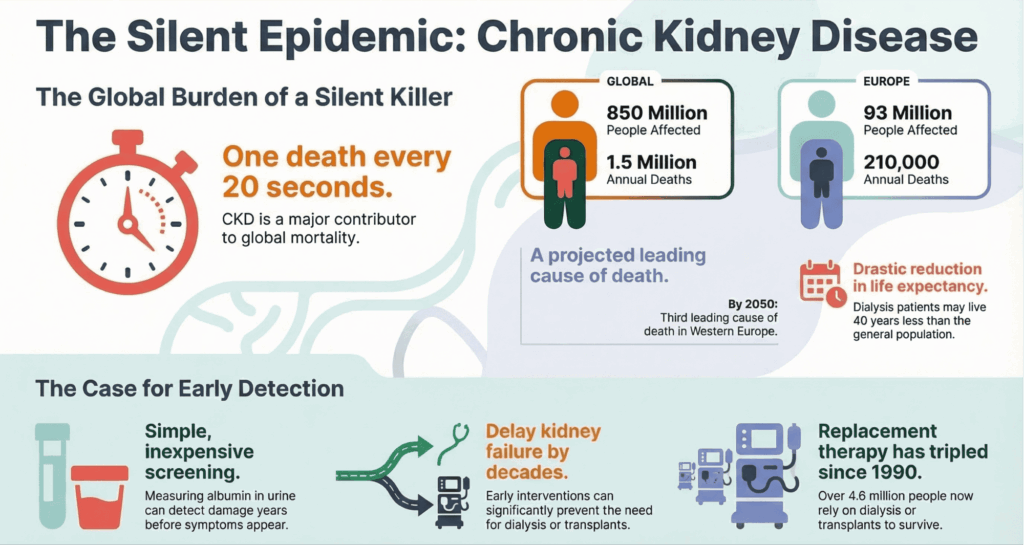
According to the latest research, involving Professor Alberto Ortiz (Fundación Jiménez Díaz-Universidad Autónoma Madrid) , a partner in the European KitNewCare project, chronic kidney disease (CKD) now affects around 850 million people globally and causes about 1.5 million deaths every year: the equivalent of one death every 20 seconds.
The figures come from updated analyses linked to the Global Burden of Disease Study, the largest effort to map health trends worldwide. What emerges from the data is a troubling picture: while progress in prevention and treatment has reduced mortality from many major diseases, kidney disease is moving in the opposite direction.
By 2050, researchers warn, chronic kidney disease could become the third leading cause of death in Western Europe, overtaking many conditions that have traditionally dominated public health priorities.
The scale of the problem is difficult to grasp at first glance. Across Europe alone, an estimated 93 million adults live with chronic kidney disease, and around 210,000 people die from it every year: one death every two and a half minutes.
Yet despite these numbers, CKD remains one of the most under-recognised global health threats. Unlike heart disease or cancer, kidney disease often advances unnoticed. Many patients do not realise anything is wrong until their kidneys have already suffered significant damage.
In clinical terms, chronic kidney disease is diagnosed when the kidneys’ ability to filter waste from the blood declines or when early markers of kidney damage persist for more than three months. But because the condition progresses slowly and silently, large numbers of people remain undiagnosed, even though early detection could dramatically change the course of the disease.
This lack of awareness has real consequences. When kidney disease advances to its final stages, patients may require kidney replacement therapy (dialysis or transplantation) simply to stay alive.
Globally, more than 4.6 million people now rely on dialysis or kidney transplants, a figure that has nearly tripled since 1990.
These treatments are life-saving, but they do not fully replace the complex functions of healthy kidneys. Patients undergoing dialysis can face dramatically shortened life expectancy, sometimes more than 40 years less than the general population, while even transplant recipients may live around two decades less than people without kidney disease.
Behind these stark statistics lies a paradox. In recent decades, major advances in public health have significantly reduced deaths from conditions such as stroke and heart disease, thanks to strong prevention strategies, early screening programmes and targeted treatments. Kidney disease, however, has not benefited from the same level of attention.
The new analysis suggests that this imbalance may soon reshape the global health landscape. While deaths from cardiovascular disease are projected to decline substantially in the coming decades, the burden of chronic kidney disease is expected to continue rising.
For researchers, the message is clear: the fight against kidney disease must begin much earlier.
Simple and inexpensive tests (such as measuring albumin in urine, an early signal of kidney damage) could allow doctors to detect the disease years before symptoms appear. Early interventions can delay kidney failure by decades, preventing suffering for patients and reducing the enormous costs associated with dialysis and transplantation.
The study also highlights inequalities in access to treatment across Europe. In some countries, patients are far more likely to receive kidney transplants than in others, revealing important differences in healthcare systems and treatment availability.
Ultimately, the findings point to a broader challenge for health systems worldwide. As populations age and chronic diseases become more common, kidney health is emerging as a critical piece of the puzzle, one that cannot remain in the shadows.
For the KitNewCare project, which focuses on building more sustainable and patient-centred kidney care pathways, the research reinforces the urgency of improving prevention, diagnosis and treatment across Europe.
Because behind the statistics lies a simple truth: while chronic kidney disease may progress silently, its impact on patients, families and healthcare systems is anything but quiet.
And unless stronger action is taken, the world may soon discover that one of its most dangerous epidemics has been hiding in plain sight.
Read the paper here
*Cover photo by CDC on Unsplash


Beyond carbon: the parts of sustainable kidney care that are still missing

An open library of kidney care life cycle data, free for anyone to reuse

Modality matters less than you think. What happens to the plastic matters more.
