
Beyond carbon: the parts of sustainable kidney care that are still missing
The project’s approach paper, published in the Journal of Nephrology, sets out the logic. Rather than a conventional environmental assessment, KitNewCare works from a four-factor life cycle assessment covering health outcome, environmental impact, social impact and cost, on the argument that no existing database links clinical outcomes to that fuller picture at the level of a department or a care pathway. Around that sit quality improvement cycles at four clinical sites in four countries, training packages in English, Spanish, Polish and Italian aimed at nephrologists, technologists, kidney pharmacists, dieticians and dialysis nurses, and an innovation strand run with industry and SMEs. The paper’s framing is deliberately uncomfortable: it states that dialysis as currently delivered is not sustainable in the medium term. The context it cites is familiar but worth restating, around 850 million people worldwide live with chronic kidney disease, roughly 660,000 people in Europe are on kidney replacement therapy at a cost of some €13 billion a year for haemodialysis and peritoneal dialysis alone, and dialysis carries an annual footprint estimated at 3.8 to 10.2 tonnes of CO2-equivalent per patient.
How much of that has actually been studied is the subject of a completed scoping review. Screening 2,512 records and including 95, the review mapped interventions into 16 categories, with water use, waste management and procurement optimisation the best represented. Its gaps are more instructive than its findings. Of the 95 included studies, 58 addressed haemodialysis and only five peritoneal dialysis, six transplantation and one conservative care, an almost complete absence of evidence for patients managed without dialysis. Pharmaceutical waste was barely addressed. Only a minority of interventions reported quantitative outcomes at all. And across the framework used to assess them, the domain concerning intended adopters was consistently the least represented: staff engagement, patient perspectives and whether changes actually stayed in place were the things least often reported. No included study directly compared environmental savings between kidney replacement modalities.
The review’s recommendations follow from that: align to ISO 14040/44, standardise reporting, prioritise the modalities and settings that have been neglected, and co-design with patients and staff rather than for them. It also notes, usefully for anyone making a business case, that many interventions were cost-saving or cost-neutral.
The social dimension is being tackled directly. A scoping review protocol published in PLOS ONE sets out to map the social dimensions of kidney care pathways across four groups: patients, informal carers, healthcare staff and, unusually, the industrial and supply chain workers who manufacture, distribute and dispose of kidney care equipment. It will examine issues including health and safety, working time, forced and child labour, discrimination and workers’ rights, drawing on social life cycle assessment methods. The protocol is registered and the searches began in August 2025, with completion anticipated in early 2026. It is a plan rather than a result, and none of its questions should yet be read as findings, but it marks out territory that the environmental literature has left almost untouched.
A perspective article in the American Journal of Kidney Diseases, co-authored by researchers involved in the project, argues that the technology itself is the deeper constraint. Peritoneal dialysis and haemodialysis have seen few fundamental changes since the 1980s; roughly two thirds of people who need kidney replacement therapy do not receive it. Dialysate-regenerating systems would cut water use by an order of magnitude and make treatment far less dependent on infrastructure. The authors’ diagnosis is about funding rather than ideas, contrasting the $17.6 million awarded across 76 projects by one major innovation prize programme since 2019 with an estimated $526 million to bring a single complex medical device to market.
Running alongside all of this is the project’s patient and public involvement programme, reported in deliverable D6.3, which treats patients as experts by experience rather than subjects, uses an established European patient federation’s annual summit as its main consultation platform, and includes patients on the project’s advisory board. The same deliverable documents joint work with two sister projects funded under the same call, on shared metrics, waste management and policy engagement.
Related readings
- Improving the sustainability and quality of kidney health care through life cycle assessments, quality improvement, education and technical innovations: the KitNewCare approach — position paper
- Advancing green nephrology: a scoping review of sustainability interventions in kidney care
- Understanding the social dimensions of kidney care pathways: A scoping review protocol — study protocol
- The Future of Technology-based Kidney Replacement Therapies: An Update on Portable, Wearable and Implantable Artificial Kidneys — perspective article
- Desafíos ambientales en hemodiálisis: explorando la ruta hacia la sostenibilidad
- D6.3 Stakeholder End-User Report — project deliverable
- KitNewCare project leaflet — project material
- KitNewCare project roll-up — project material
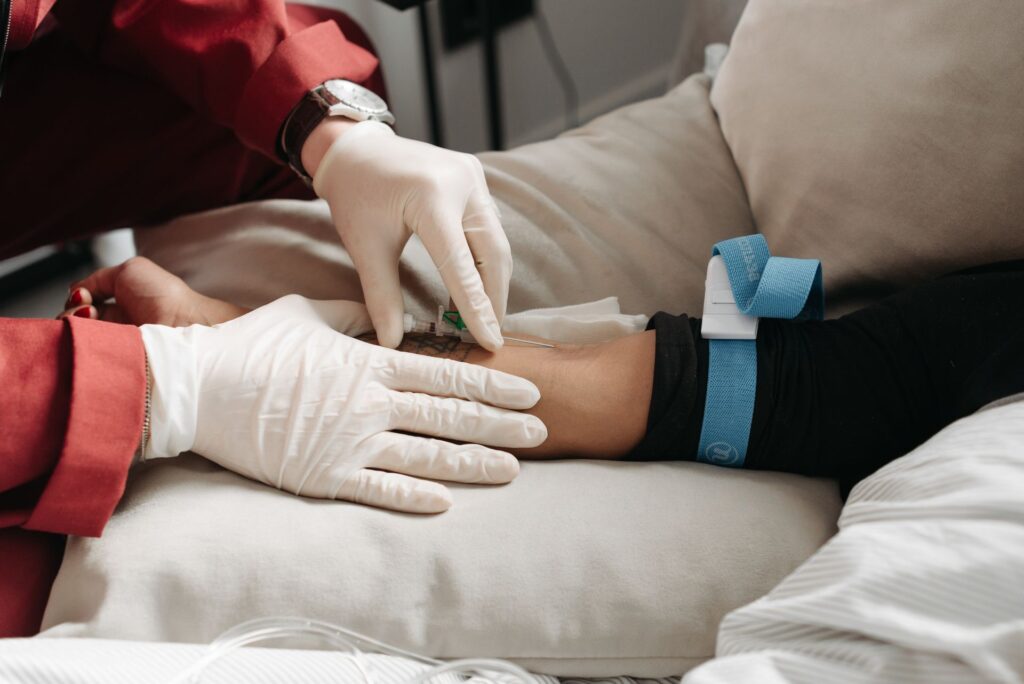
*Photo by Pavel Danilyuk


An open library of kidney care life cycle data, free for anyone to reuse

Modality matters less than you think. What happens to the plastic matters more.

Small actions, measured properly: what really moves water, energy and waste in a dialysis unit
